

Dhanbahadur magar
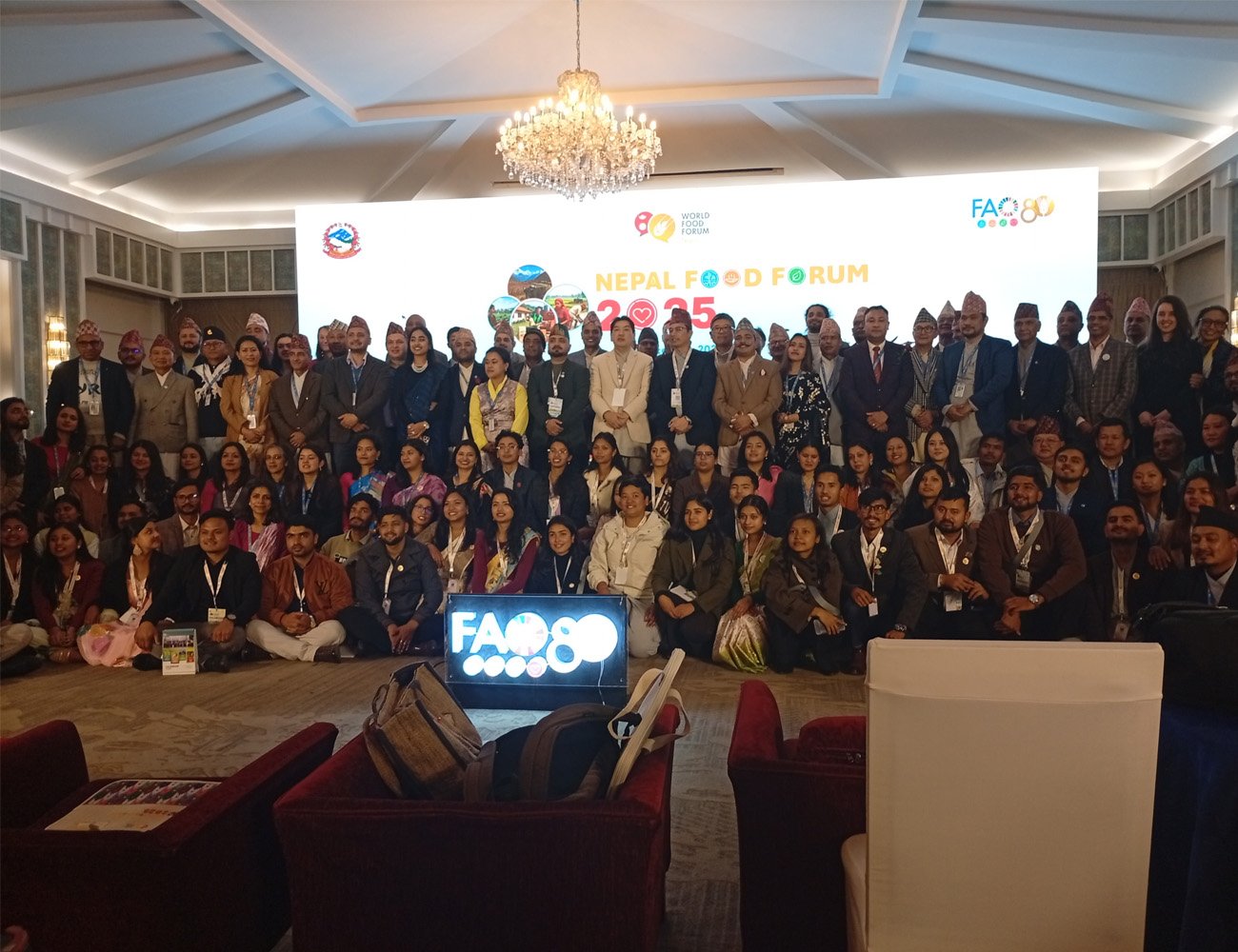
Kathmandu, December 15, The Nepal Food Forum 2025 (NFF 2025) convened government leaders, youth innovators, private sector actors, researchers, indigenous representatives and development partners to advance Nepal’s transition towards inclusive, climate-resilient and investment-ready agrifood systems. The Forum was jointly organized by the Food and Agriculture Organization of the United Nations (FAO) and the Ministry of Agriculture and Livestock Development (MOALD) and held at Hotel Himalaya, Lalitpur.
Anchored in Nepal’s Decade of Agriculture Investment (2024-2034) and aligned with FAO’s global agenda, NFF 2025 served as a national platform to mobilize partnerships, promote youth-led innovation and showcase scalable solutions that strengthen food security, rural livelihoods and sustainable economic growth.
Opening the Forum, Honourable Minister Dr Madan Prasad Pariyar, Ministry of Agriculture and Livestock Development, emphasized the Government of Nepal’s commitment to modernizing agriculture through innovation, investment and inclusion. He highlighted the importance of engaging youth, women and indigenous communities as central drivers of agrifood system transformation, noting that inclusive participation is essential to achieving long-term productivity and resilience.
Reaffirming the Government’s new vision, Honourable Minister Dr Madan Prasad Pariyar emphasized that youth are the backbone of Nepal’s agricultural future and play a decisive role in increasing productivity, competitiveness and sustainability, particularly under the Decade of Agriculture Investment (2024-2034). He highlighted ongoing efforts to create an enabling environment for youth through supportive policies, entrepreneurship promotion, skills development, access to finance and strengthened market linkages. The Honourable Minister also underscored the growing contribution of youth-led agribusinesses and climate-smart farming initiatives in generating employment, adding value to agricultural products and revitalizing rural economies. He stressed the importance of ensuring the inclusion of young women, indigenous youth and youth from remote and mountain regions, so that agrifood transformation is equitable and leaves no one behind.
Speaking at the inaugural session, Mr Ken Shimizu, FAO Representative for Nepal and Bhutan, underscored the critical role of youth in shaping the future of Nepal’s agrifood systems. He emphasized that young people are no longer only beneficiaries of development interventions, but key actors and partners in agrifood transformation. According to Mr Shimizu, youth bring innovation, technological skills and entrepreneurial energy that are essential to addressing persistent challenges such as climate change, food insecurity, rural unemployment and outmigration.
Mr Shimizu further highlighted FAO’s continued commitment to empowering youth through global and national initiatives, including the World Food Forum and the Hand-in-Hand Initiative, which provide young people with access to knowledge, innovation platforms, investment opportunities and policy dialogue. He noted that investing in youth-led agribusinesses, agritech solutions and green jobs is fundamental to building resilient, inclusive and sustainable agrifood systems. Meaningful youth engagement across the entire value chain from production and processing to marketing, digital innovation and governance was emphasized as a prerequisite for long-term food security and rural prosperity.
Reflecting on FAO’s 80th anniversary, Mr Shimizu highlighted FAO’s long-standing partnership with Nepal and noted that NFF 2025 reflects FAO’s vision of working hand in hand to achieve better production, better nutrition, a better environment and a better life for all.
Ms Hanaa Singer Hamdy, United Nations Resident Coordinator in Nepal, highlighted the importance of integrated, multisectoral approaches to agrifood system transformation. She emphasized that resilient food systems are central to achieving the Sustainable Development Goals (SDGs) and called for stronger collaboration across agriculture, nutrition, climate action, health and social protection. She underscored the need to place people particularly youth, women and marginalized communities at the centre of development efforts to ensure that no one is left behind.
Representing the Ministry of Forests and Environment, Dr Rajendra Prasad Mishra, Secretary, MoFE, highlighted the close linkages between agriculture, biodiversity conservation and climate resilience. He emphasized the importance of promoting nature-positive agriculture, sustainable land management and ecosystem-based approaches to strengthen food security while safeguarding Nepal’s rich natural
resources.
Similarly, Dr Deepak Kumar Kharal, Secretary, Ministry of Agriculture and Livestock Development, underscored the Government’s focus on evidence-based policymaking, innovation and partnerships to drive agrifood transformation. He highlighted the role of science, technology and data in improving productivity, resilience and sustainability across agricultural value chains.
During the Forum’s panel discussions and thematic sessions, participants explored practical solutions to accelerate agrifood transformation. Panels highlighted the role of science and innovation in improving productivity and resilience; digital technologies and data-driven tools in disaster risk reduction and early warning; and climate-smart and nature-positive practices in safeguarding food systems and biodiversity. Discussions also emphasized the importance of addressing antimicrobial resistance within a One Health framework, strengthening food safety and promoting sustainable livestock and aquaculture systems. Youth-led panels and experience-sharing sessions showcased innovative agribusiness models, agritech solutions and community-based initiatives led by young farmers, entrepreneurs, women and indigenous groups. These sessions underscored the need for better access to finance, incubation support, market linkages and policy spaces to scale youth-led innovations.
The Forum also spotlighted investment-ready agribusiness opportunities under FAO’s Hand-in-Hand Initiative, including priority commodities such as large cardamom, ginger, mountain honey, yak cheese, highland potato and Pangasius fish. Panel discussions highlighted the potential of these value chains to generate rural employment, enhance exports and strengthen climate resilience, particularly in mountain and marginalized areas.
Dedicated sessions amplified the voices of youth, rural women, persons with disabilities and indigenous peoples, recognizing their traditional knowledge, leadership and role as custodians of biodiversity. By integrating science with local wisdom, the Forum promoted inclusive and locally grounded pathways for sustainable agrifood development.
By convening diverse actors across sectors, Nepal Food Forum 2025 strengthened collaboration between government institutions, the private sector, research organizations and development partners. The Forum is expected to contribute to policy dialogue, investment mobilization and youth-led action, supporting Nepal’s ambition to build resilient, inclusive and sustainable agrifood systems for present and future generations.
Comment: