

Rights of women farmers shrinking due to male-dominated, patriarchal social structure: Khadka
Dhanbahadur magar
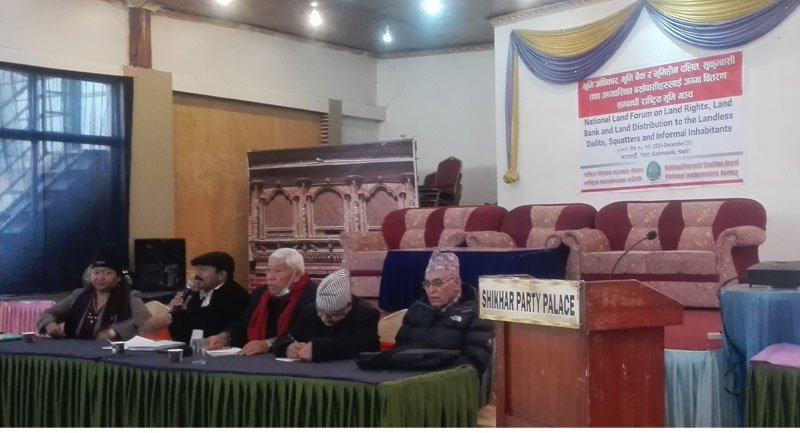
Kathmandu, December 28, National Peasants Coalition, National Implementing Committee organized a program on the role and contribution of female farmers in Nepal through the National Farmers’ Forum on women farmers’ rights and representing at the government’s policy-making level.
Vice President of All Nepal Peasants Federation (Revolutionary Center), Member of the House of Representatives, Agriculture and Natural Resources Committee member Meena Tamang, said that the family farming systems operated by the United Nations already has been running in Nepal for a long decades. Before the launching the family farming program by the United Nations Food and Agricultural Organization.
Tamang emphasized that to solve the problem in agriculture, She said, we should all work together to solve it. Foreigners will not come to bring and to solve the any program, we should will do it ourselves.
We will also solve the problem. The situation of our Nepali society is being watched by one person to another. The character of the country is that the lower house does not look at the upper house. We are people at the ground level, policy is also at the level. If we unite we can get rights.
General Secretary of All Nepal Pesants Federation (Revolutionary Center), former Vice Chairman of National Land Commission, Coordinator of National Peasants Coalition, Nahendra Khadka, said that the the concrete role of women farmers is increasing in Nepal.Stating that women should fight more for more rights, women who have contributed significantly to the political changes of the country are also having to fight for their rights.He said that women who fought together for equality But in this context their rights have shrinking due to the male-dominated and patriarchal social structure. It is still necessary to wait for the man to make a decision. Khadka said.Highlighting the importance of the program, Khadka said that women play a prominent role in Nepal’s agriculture sector yesterday and today. He said that to get the rights of women farmers, it can be done only by accessing the policy making.
In the program, the Acting General Manager of the Central Agricultural Cooperative Association, Mina Pokharel, presented a working paper on the Decade of Family Farming and Participation of Women Farmers in Nepal. She said that the participation of women in the agricultural sector is above 70 percent.
Even in today’s situation, I have found that only women and women in agriculture sectors. She said that in the context of the United Nations Family Farming Decade 2018-2029, Nepal’s agriculture sectors previously had a family farming system since the past.
She said that not only in Nepal but also the most of the Asian countries, the participation of women farmers in rural areas and the role of women in the family farming system are expressable.
The treasurer of the All Nepal Peasants Federations Dayalakshmi Shrestha, she asked who are women ? Why women farmers are left behind ?
While presenting a working paper on the subject, Shrestha said that the farmers in the rural areas who does real labor, are discriminated against, putting the rich, poor, small and big farmers together. Even in that, women are lagging behind.
Army, police, employees have pension but those who wake up at 4 clock in the morning and work till to at 9, to night do not appreciate any contribution of women. Appreciated Nepali women farmers are suffering a lot.
Shrestha said that even today rural areas contribute 70 percent above agriculture sector and said that since women play a vital role in preserving agriculture, the state should bring a special policy to protect women’s rights.
Member of the cooperative board and chairman of all Nepal Herbs Association, Ishwari Pandey, said that we cannot study the poverty line of situation without studying the geography of Nepal. In addition, Pandey said that in the context of Nepal, sustainable development can only proceed to improve the breed and adding to Indigenous crops rather than improving the caste.
President of Sana Kisan Sahakari Sangh Kavre, Sarita Neupane (Bajgai), said that Kavre district, Nala is an agriculture pocket area. Bajgai said that although there is animal insurance in agriculture, there is no crop insurance and it should be added to crop insurance.
In addition, she said that the farmers could not brought their crops because wild animals including wild boars came and ate the crops, planting by the farmers.
Bajgai said that although women produce, process and sell in the market, they cannot even spend without men’s permission. Men go to the furnace and spend. Women do not make the decision to buy clothes at once.
All Nepal Peasants Federation (Revolutionary Center) Lalitpur, President Sita Timalsina said that past time keeping 2000 layers of chickens, they have suffered from by the COVID-19, and huge losses due to COVID Pandemic. They did not get help from the government or anywhere else. Chickens does not included in insurance package.
Duwakot women farmer leader Sumitra Kandel said that some women do not know what that we are farmers. She said that she should go to the farmers and advocate for farmers’ rights. We talk about the rights of farmer women.
But we have not been able to get the right. She also said that women do not have the right to avoid problems by rearing buffaloes. It is necessary to make the women of the village aware about the rights of women farmers. She also said that women were subjected to double or triple exploitation. Secretary of the National Land Rights Forum, Viju Khand, said that as per the efforts, women should get the most rights, the discriminatory policy of the state is always making them depressed.
She said that the discrimination between men and women is being done by the state policy, whether it is in terms of allowing men and women to take loans from banks or in terms of wages, the discrimination still hasn’t gone away and they are being treated as second-class citizens.
In order to end the discrimination, culturally, the discrimination on the ground, the discrimination against the Sukumvasi, Dalit women, landless farmers appeared as a class problem.
Female leader Ganga Gurung questioned where are human rights for women. Lalpurja is available but women do not have the right to enjoy it. Women are promoted only for show and to pay less revenue.
Gurung said that the women are under the violence of the state. She said that everything will be lost from the hands of women, the use of hybrid crops and chemical pesticides will also have adverse effects on health, and women will be the first victims of diseases.
The coordinator of the Peasant Coalition, Nahendra Khadka, briefly analyzed the suggestions received from the discussions program that took place 11 points were agreed on.
1. The trend of young people going abroad is increasing, they are attracted to other professions because they does not agree to do an agriculture, and even after returning from abroad, they are also prioritize to engaged in other professions.
2. Women farmers are taking over Nepal’s agriculture, women’s rights have not been broadened politically, they have not been able to implement them in practice despite the constitution and laws.
3. It has been concluded that the problems of Sukumvasi, Dalits, Landless and Dalit women are more.
4. Even though the land is registered in the name of the woman, but she does not have the right to use it.
5. Even though women farmers work from 4 clock am to 9 pm.
6. Women do not have the right to spend ownself, Womens produce the an agricultural products produced commodities distribution and sell in the market, but they haven’t right to spend it.
7. Decision-making rights are not equal for men and women.
8. Emphasizing that wages for women farmers are very low, equal wages need to provide men and women,
9. There is no women-friendly agricultural technology, emphasis has been placed on the need to make the technology that is being developed now women-friendly.
10. Emphasis is placed on taking the program to farmers’ settlements to raise public awareness among women farmers.
11. Emphasizing the fact that women farmers should participate in the state’s policy-making mechanism, and raising the issue of warning that women farmers should be represented by others, It has emphasized that women should join the struggle for the participation of women farmers.
A 21-member National Women’s Farmers’ Forum has been formed under the leadership of Meena Tamang, vice president of the All Nepal Peasants Federation (Revolutionary Center), with will present in institutional representative of peasants’ members from the under coalitions of 20th organizations.
Comment: