

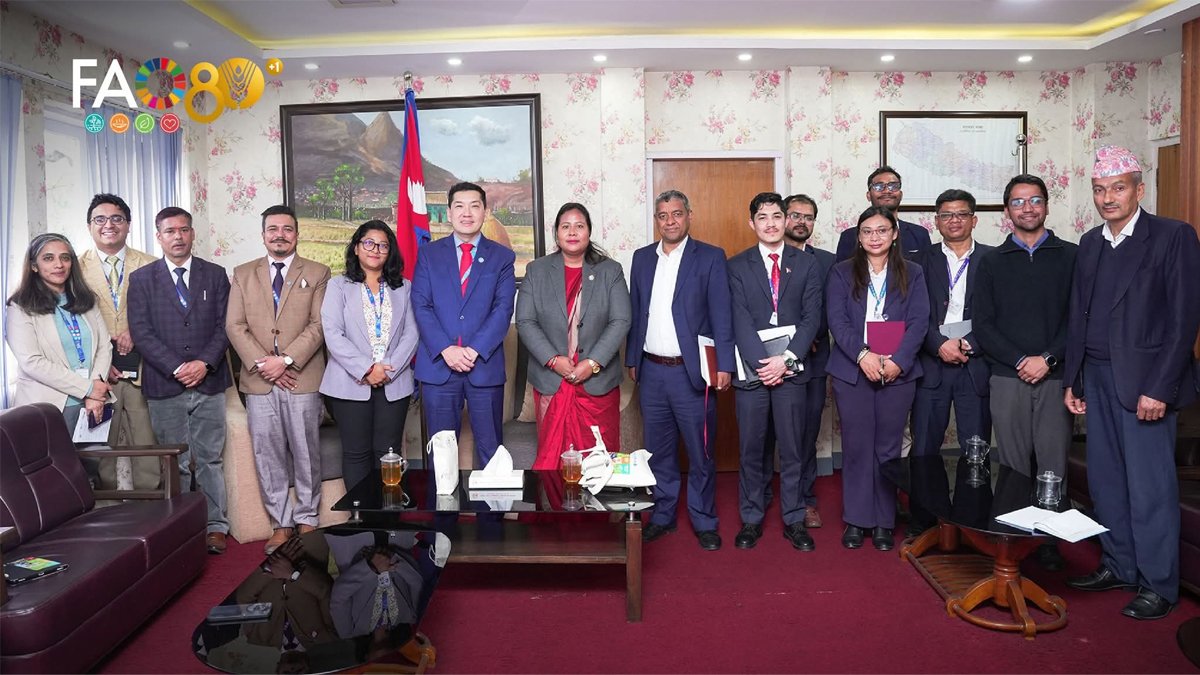
Kathmandu, April 5, Mr. Ken Shimizu, FAO Representative for Bhutan and Nepal, met today with Hon’ble Minister Gita Chaudhary, Minister for Agriculture and Livestock Development and Minister of Forests and Environment, and warmly congratulated her on her recent appointment. The meeting highlighted a shared commitment to strengthening integrated action across agriculture, livestock, forests, and the environment, building on renewed national momentum to advance climate resilience, inclusive livelihoods, and expanded opportunities for youth and women.
(ADBL) Nepal Emphasis to invest in Agriculture
Agricultural Development Bank Limited (ADBL) Nepal, and proud to have contributed as one of the four authors of a guideline manual entitled “Agriculture Production Norms” developed to calculate the required project cost (in NPR) for agricultural enterprises.
This publication marks an important step for the banking sector, as it provides a practical and systematic framework for estimating project costs across 42 types of agricultural projects, including cereals, vegetables, fruits, commercial and plantation crops, farm animals, bees, fish, and birds.
I believe this manual will greatly support banking professionals and stakeholders in making more informed, realistic, and consistent agri-business lending decisions.
I sincerely request all concerned stakeholders and bankers to use this guideline before financing
agricultural projects and to regard this publication as a valuable institutional asset.
Call for Youth Case Studies on Climate-Induced
Call for Youth Case Studies on Climate-Induced Loss & Damage in Agrifood Systems
The World Food Forum (WFF) Youth Initiative, in collaboration with the Office of Climate Change, Biodiversity and Environment at the Food and Agriculture Organization of the United Nations (FAO), is inviting submissions from youth, youth-led groups, and organizations.
This call seeks to gather locally grounded evidence and youth-led perspectives on climate-induced loss and damage in agrifood systems. The insights collected will contribute to influencing policy and financing discussions under the United Nations Framework Convention
AFU and FAO Collaboration
FAO Nepal was pleased to collaborate as a partner at Nepal’s first-ever International Beekeeping Conference, jointly organized by the Faculty of Agriculture, Agriculture and Forestry University (AFU), the Ministry of Agriculture and Livestock Development (MOALD), and the Federation of Nepal Beekeepers (FNBK).
During the conference, FAO Nepal highlighted the Hand-in-Hand Initiative, showcasing how data-driven, partnership-based investment planning can support sustainable beekeeping, pollination services, livelihoods, and biodiversity conservation in Nepal.
FAO Nepal also presented a technical paper on “Best practices and lessons learned from High Mountain Wild Honey production and its link to indigenous livelihoods in Nepal,” emphasizing its importance for mountain livelihoods, ecosystem conservation, and inclusive value-chain development.
FAO remains committed to working hand-in-hand with academia, government, producers, and part
Honored to represent FAO Nepal as a collaborating partner at Nepal’s first-ever International Beekeeping Conference 2026, jointly organized by the Faculty of Agriculture, Agriculture and Forestry University (AFU), the Ministry of Agriculture and Livestock Development (MOALD), and the Federation of Nepal Beekeepers (FNBK).
Through this collaborative platform, we highlighted FAO’s Hand-in-Hand Initiative, demonstrating how data-driven, partnership-based investment planning developed and implemented with government, academia, producers, and development partners can strengthen sustainable beekeeping, pollination services, livelihoods, and biodiversity conservation in Nepal. Contributing to the shared knowledge exchange, we also presented a technical paper on “Best practices and lessons learned from High Mountain Wild Honey production and its link to indigenous livelihoods in Nepal,” underlining the value of indigenous knowledge, ecosystem stewardship, and inclusive value-chain development in mountain contexts.
I am sincerely grateful to the Mr Ken Shimizu, FAO Representative for Bhutan and Nepal for the leadership, guidance, and continued encouragement that enable meaningful engagement and collaboration.
Comment: