

17 Apr 2026 | Press releases
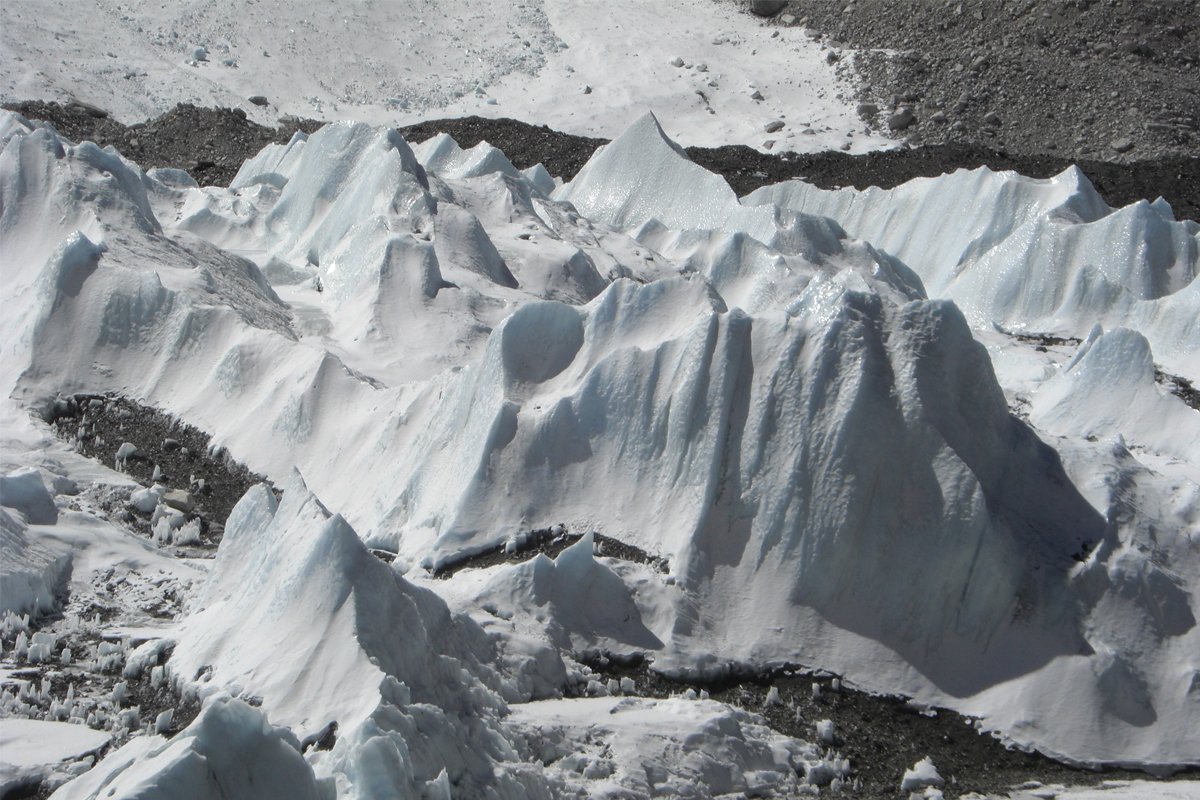
Photo: ICIMOD archive
KATHMANDU, Nepal – Earth’s glaciers outside of the Greenland and Antarctic ice sheets lost 408 ± 132 gigatonnes (Gt) of mass during the hydrological year 2025, the second-highest annual loss on record, according to a major new study published in Nature Reviews Earth & Environment by the World Glacier Monitoring Service (WGMS) network. The findings, which also appear in the European State of the Climate Report 2025, reveal a decade-long acceleration in global glacier mass loss that now totals 9,583 ± 1,211 Gt since 1975 – equivalent to 26.4 ± 3.3 mm of cumulative sea-level rise.
Mohd. Farooq Azam, Senior Intervention Manager-Cryosphere at the International Centre for Integrated Mountain Development (ICIMOD), is also one of the authors of the study. The study was compiled by the WGMS and draws on glacier mass-change observations from national monitoring networks and research institutions worldwide, using geostatistical modelling to combine in situ data with long-term remote sensing records.
Scale and pace of global ice loss
Annual glacier mass loss has more than quadrupled over the past five decades, rising from under 100 Gt per year in the period 1976-1995 to approximately 230 Gt per year between 1996 and 2015, and reaching around 390 Gt per year between 2016 and 2025. Six of the ten highest annual mass-loss years on record have occurred in the past seven years. To put the scale of the 2025 figure into perspective, WGMS Director Michael Zemp noted that the annual loss would have filled five Olympic swimming pools in every second of the year.
Regional contributions to global mass loss in 2025 were greatest from High Mountain Asia, Alaska, and the Russian Arctic. The largest anomalies compared to the 1991-2020 climate baseline were recorded in Western Canada and the USA, South Asia West, and Svalbard.
Hindu Kush Himalayan glaciers: monitoring gaps and water security at stake
For ICIMOD, the findings carry special urgency for the HKH region. The HKH region – sometimes called the Third Pole – is a critical freshwater source that partly caters to the freshwater requirement of nearly two billion people across the region’s eight countries: Afghanistan, Bangladesh, Bhutan, China, India, Myanmar, Nepal, and Pakistan.
“Despite being home to the largest concentration of glaciers outside the polar regions, the HKH remains underrepresented in global glacier datasets. Recent efforts have improved glacier monitoring in the HKH, but coverage remains limited. Expanding long-term, standardised observations is essential to ensure improved regional representation in global assessments and future climate risk projections.” – Mohd. Farooq Azam, Senior Intervention Manager-Cryosphere, ICIMOD, and co-author of the study.


Comment: