

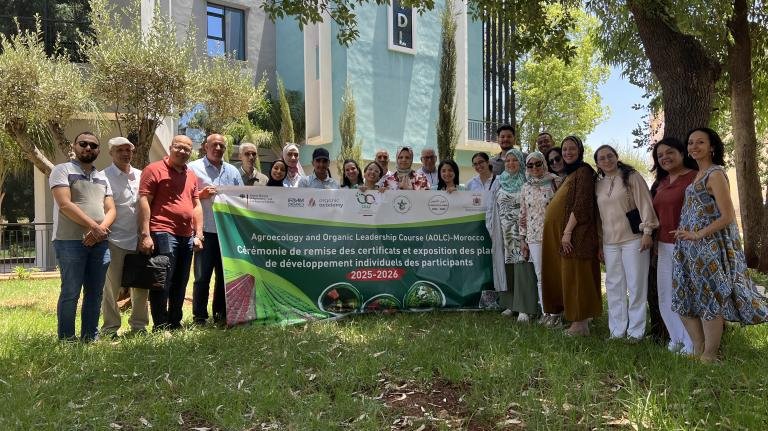
Kathmandu July 7, Following an intensive nine-month learning journey, the Agroecology and Organic Leadership Course (AOLC) Morocco cohort gathered at the National School of Agriculture of Meknes (ENA Meknes) from 29 June to 1 July 2026. The gathering celebrated the cohort’s graduation and provided a platform for participants to showcase their visions for a more resilient, sustainable, and inclusive food system.
This second face-to-face session marked the culmination of a programme designed to focus on transformation at the food system level while strengthening leadership for the emerging future. The event brought together 23 graduates to share their development plans and strategize how to embed their initiatives at both national and sub-national levels.
As a pioneering Moroccan university with a reputable Faculty of Agroecological Engineering, ENA Meknes proved to be an exceptional and vital institutional partner for this training. High-level leadership from the university attended the graduation to honour the participants, including:
” Said Amiri, Director, ENA Meknes
” Jo Cadilhon, PhD, Science Partnership Coordinator
” Fouad Rachidi, Director of Research, Cooperation, and Partnerships
” Martin Baumgart, Head of the Organic Agriculture Component, German-Moroccan Technical Dialogue on Agriculture and Forestry (DIAF)
” Fatima Zahra Elmiri, National Coordinator of DIAF Project
From Systems Thinking to Community Actions
The three-day face-to-face programme featured nine sessions covering key pillars of agroecological and organic transition, alongside change enablement. Key topics included:
“Policies and advocacy for organic farming and agroecology: Exploring regional dynamics and the Moroccan context.
“Strategies and approaches to mobilise support: Engaging public entities at the subnational level.
“The role of Development Projects: Understanding how specific projects contribute to agroecology and the creation of “Bio-territories”
“Intrinsic qualities of the change agents: Fostering personal and leadership development.
“Territorial mapping and integration: Embedding individual development plans into broader territorial action plans.
Delivered by Patricia Flores, Senior Manager Global Academy, and co-trainer Jouhaina Riahi, with an outstanding contribution from Sahar Brahim, policy advocacy expert from IFOAM – Organics International, these sessions helped cultivate a systems-thinking mindset within the cohort, anchoring their Personal Development Plans within Morocco’s policy landscape.
Top Development Plans from the Cohort
Following an interactive and participatory peer review, three of the 23 Development Plans (DPs) stood out for their exceptional design, high potential for impact, and the leadership quality of the changemaker:
Turning a new leaf for the Moroccan Agroecological and Organic Movement
While the AOLC Morocco has drawn to a close, the real-world impact of these change agents is just beginning to take root. Equipped with advanced skills in leadership, systems thinking, stakeholder engagement and change management, these graduates now serve as vital links in growing a regional and global network dedicated to promoting agroecology and the principles of organic agriculture.
By championing localised, systemic interventions, this cohort is elevating leadership standards across Morocco’s organic and agroecology communities. Their efforts will ensure that agroecology plays a central role in shaping the country’s future food security and better nutrition outcomes.

Comment: