

Kathmandu September 17,
This will follow one of the worst agricultural years on record in Europe, with yields at historic lows in some countries. The summer saw roughly half of the land area of the EU and UK fall under drought conditions just as geopolitical disruptions caused oil and fertilizer prices to spike – a climate shock that landed on top of an input shock.
For small-scale producers in drought- and flood-prone regions around the world, this double burden is already familiar. Eleven countries – home to 282 million rural people – rank in the top third globally for both drought exposure and fertiliser cost-share increases, leaving rural communities particularly vulnerable to shocks.
But El Niño is one of the few shocks that can be forecast months ahead – leaving a real window to act. Across IFAD-supported projects, what distinguishes resilient farms is that adaptation and mitigation measures are in place well before the next shock arrives. These farms on the frontlines of droughts, floods and erratic weather offer lessons in resilience that farmers everywhere can learn from.
1. Act on the forecast, not the shock
IFAD invests in climate information services so that forecasts reach farmers and enable them to make informed planting and harvesting decisions ahead of time. But greater resilience can be achieved by applying the same logic to insurance – arranging it when the forecast is issued, not once the drought has bitten.
In Kenya, the KCEP-CRAL programme -?co-financed by IFAD and the European Union – built drought insurance into farmers’ input purchases at planting time and linked payouts to satellite data, meaning farmers received insurance money when data showed significantly reduced crop yields. When drought hit between 2020-2022, nearly 60,000 insured farmers were paid automatically, reducing the need to sell assets.
A farmer participating in KCEP-CRAL accesses agricultural insurance through her phone in Kenya.
2. Invest in stress-tolerant crops
Stress-tolerant crop varieties are among the cheapest forms of adaptation, especially because they do not create any disadvantage in non-drought years. The cost of not adapting, on the other hand, is stark: a study of Zambian small-scale farms showed that the 2015-16 El Niño cut maize productivity by 46 per cent.
In Nepal, drought-tolerant rice varieties introduced through the IFAD-funded CURE programme raised average yields by almost 30 per cent over local landraces while reducing year-to-year variability. Four years after the project closed, nearly 60 per cent of non-participating farmers in CURE-supported villages had also adopted them.
3. Make efficient use of water and energy
Resilient producers secure every available drop of water before drought peaks, from efficient irrigation to water harvesting and soil-moisture management. But irrigation is only as reliable as the energy that drives it. Diesel powers nearly three-quarters of the energy used for irrigation pumping worldwide, so a fuel shock can easily result in water stress.
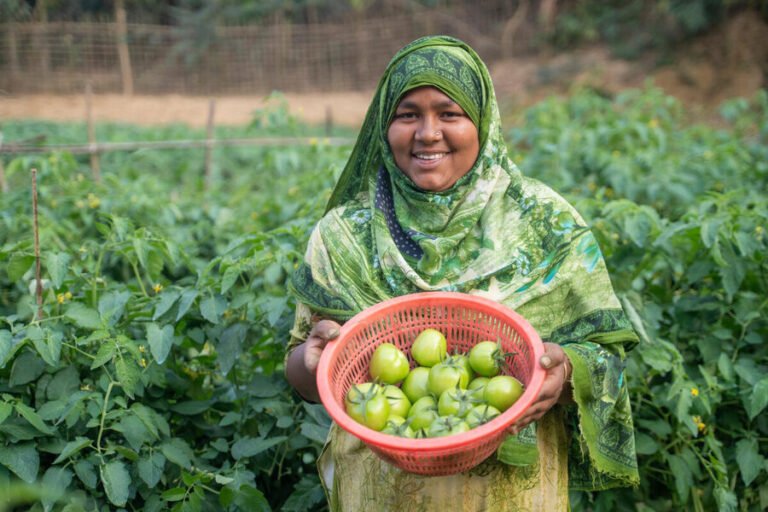
In Bangladesh, the IFAD-supported RMTP project replaced diesel pumps with solar-powered irrigation on off-grid char lands, cutting seasonal pumping costs by 60 per cent and decoupling production from oil prices.
Farmers participating in the IFAD-supported SAIL project in Egypt also replaced diesel-powered irrigation with a solar-powered system.
4. Diversify crops, income and inputs
The most resilient farms rarely depend on a single crop, market, energy source or supplier. Diversification distributes risk across multiple income sources and reduces dependence on vulnerable supply chains. Fertilizer markets are especially concentrated: the typical importing country sources 85 per cent of its phosphate from a single supplier.
In Indonesia, the IFAD-supported READ SI project trained rural communities in composting and organic soil management through farmer field schools, reducing dependence on purchased fertiliser while improving soils. This diversified not only what is grown but where inputs come from, contributing to income increases for 76 per cent of participating households.
A participant in the READ SI project applies compost to his
Continue …. 31 page
Preparing for EL Nino
rice field in Sulawesi, Indonesia. © IFAD/Jefri Tarigan
5. Think beyond the farm: bundle inputs, finance and markets
Resilience is ultimately a property of systems, not just of farming practices: climate-proofing a farm may not make a difference if the finance and market systems around it remain vulnerable.
That’s why IFAD bundles interventions for maximum impact. In Kenya, KCEP-CRAL combined insurance with drought-tolerant inputs distributed through local agro-dealers and community warehouses. In Bangladesh, households received not only solar irrigation systems but contracts with a premium buyer, showing income growth of 50 per cent, compared to 22 per cent in control groups.
________________________________________
The impacts of El Niño are likely to be significant, with a more than 90 per cent chance of a very strong event in late 2026 and into 2027. But IFAD’s investments show that investments in resilience both on and off the farm enable small-scale farmers to withstand even the strongest shocks – or recover faster if disaster strikes.
IFAD’s upcoming COP31 report will provide further insights into the impacts of El Niño on small-scale agriculture and potential solutions.
Comment: